Click “Send”

Two days ago I sent off my query letter and the first ten pages of my gender-swapped version of Treasure Island. 😬

I attended a writing workshop in May and signed up for two pitches with literary agents. One indicated an interest in my novel and provided me the email address for requested submissions. Why wait this long? Well for one thing, the agent said we had until the end of the year to do so. But most importantly — I needed to edit the novel yet again.

I had already edited the novel several times. Even so, I found plenty more changes to make. When I reached the end of the most recent go through I forwarded the novel to my first reader. She is a graphic artist who once worked at a small local press designing some of their books. She’s also an avid reader (for herself and with her young children) and listens to audio books. We had fruitful discussions about the novel that informed yet more edits. A friend of hers who teaches fourth grade squeezed in time to read my first ten pages and made insightful suggestions.

Using their feedback I worked on the query letter and first ten pages until it was time to just send off my submittal.

But I’m not done editing the novel. My readers had zeroed in on my most consistent shortcoming that I am now attempting to address.

I joined one of (I’m sure) a zillion writers groups on Facebook. Comments and questions are posted by first-time writers to experienced, published authors. If you want to receive a large number of comments on your post, just post “I just finished my first novel. How do I get an agent?”

I like Anne Lamott’s “shitty first draft” philosophy. It frees up the writer to just write! Don’t expect perfection. The first version is supposed to be lousy. Congratulate yourself for climbing the mountain. Celebrate in whatever manner is appropriate for you, rest on your laurels for a period, and then start editing!

The novice writer is inundated with replies pretty much along that line. Edit and edit again.

Of course, at some point you have to say you’ve done all you can. Time for a professional to look it over. Whether contracting a professional editor before submitting or self-publishing, or pitching to agents and editors in hopes of piquing their interest.

It’s exciting to have an agent or editor to express interest in your efforts. It’s also nerve wracking. A generic rejection can be devastating. A “not for us” response can be hopeful. If not them, maybe someone else. So, fingers crossed while waiting for a response.

I’ve immersed myself in my Treasure Island novel all summer and I’m still fiddling with it. For mental breaks (aside from the dog dragging me outside, reading, and watching Britbox or Acorn offerings) I’m now turning to another completed novel that needs significant changes.

A loss…

My gelding crossed the Rainbow Bridge in early September. It’s always difficult to make the decision to let go of one of our beloved four-legged family members, but the vet confirmed it was time. He turned 30 this year; we had 27 years together. He “retired” when my arthritic hips grounded me. Most recently he was allowed free range of the boarding facility and proved to be quite the character. Someone always had a story to tell on him when I arrived at the barn. He often sauntered into the arena to hang out with the trainer during lessons. And he was known for cantering in from the jump field out back to trot up the barn aisle much to the alarm of everyone grooming or tacking up. That’s my guy.

Wait! Stop Everything! Is That Historically Correct?

I’ve been focused on editing (again!) my Treasure Island inspired novel. I thought it might be the most marketable and worth the effort to keep working on it. I’m making the usual changes to eliminate superficial words, phrases, and paragraphs as well as attempting to clarify story elements for the reader. Per usual I’m layering in more character development.

However, all of this comes to a screeching halt when I stumble on elements of historical accuracy! Writing and editing are set aside as I dive into the fathomless Research Well. Was that word used in 1834/1835? How did firearms of the era work? Was that card game still popular post Regency?

One of the advantages of writing Science Fiction and Fantasy is building your own world. Most fantasy novels are based on or inspired by actual historical cultures and/or periods. But you can make whatever alterations that suit the story as long as you can make the elements seem reasonable. Magic is always helpful with author-established parameters and limitations for the story world. Genius inventors can introduce technology a century or two earlier in your fantasy setting. Parallel universes can make incongruities acceptable.

Science Fiction has a basis in actual science. But there is always the opportunity to extrapolate current cutting edge science into the future. Or apply a “reasonable” tweak to known science to take it in a new direction. As long as the author can establish a non-magical explanation so the reader can “suspend disbelief” the story is good to go.

But I chose to set my novel in 1834/34 England and on a Caribbean island. I selected those years because of an actual event in the future Queen Victoria’s life. What was I thinking? Because I decided my protagonist would share a birthdate (and perhaps a cosmic connection) with the future queen.

Anyway — I am comfortable with fashion history and the world of horses. I’ve read 19th century novels and watched period movies and series. They provide some information about society of the period, but not necessarily the nitty gritty details (and movies are notorious for inaccuracies). So I did online research before writing, but in the process of writing the first draft and now editing for the umpteenth time I continue to encounter the need for additional research.

And everything comes to a stop while I attempt to discover how something was done then, whether something had been invented yet, what the social customs of the period were, and so forth. As is often the case in diving down the research hole, an exorbitant amount of time may be spent looking up the tiniest, fleeting detail. Instead of knocking out the next chapter or two, or editing several pages, the entire time set aside for writing is spent researching fashionable waistcoats, Christmas tide menus, or creepy crawlies of the Caribbean islands.

Then again, getting sidetracked by research has solved more than one story element. I discovered there was, indeed, a wine made especially for Napoleon. And I learned Princess Victoria’s first attendance at the Royal Ascot races ties in perfectly with my storyline.

Sometimes hitting a stone wall and researching a way around, over, or beneath it pays off.

Life Happens

Twenty-twenty hindsight tells me I should have seen my doctor sooner. But I did not associate the odd issues I was experiencing with a specific illness. After I finally made an appointment in June I embarked on a medical “adventure” that lasted the remainder of 2024. Doing okay now — but I was benched for a while there.

I did manage to peck away at my umpteenth edit of Quest for the Thing and I’m nearly done with it. And I muddled around with ideas for The Crystal Sword, my latest story idea. I settled on photos grabbed off the Internet for the main characters, and I’ve gone through several iterations of names for the characters. I have a secret background for the main character, an idea for the opening scene, and a concept for the climactic scene. Lots to figure out for what happens in between.

Nothing like reading other books inside and outside the genre of the novel-in-progress (or hope to be in progress) for story ideas. I started taking notes from a popular YA novel on family dynamics within a rich household. And got a nonfiction book about a very powerful medieval family to study for political machinations as well as family dynamics. I received a copy of Percival Everett’s James for Christmas and decided to reread the origin story, The Adventures of Huckleberry Finn, before starting James. Man, it has been awhile! Like reading it for the first time. But it’s given me some potential plot ideas. From the rural southern slave states of the U.S. to a fantasy novel with centaurs? Well, very general ideas for moving the characters about.

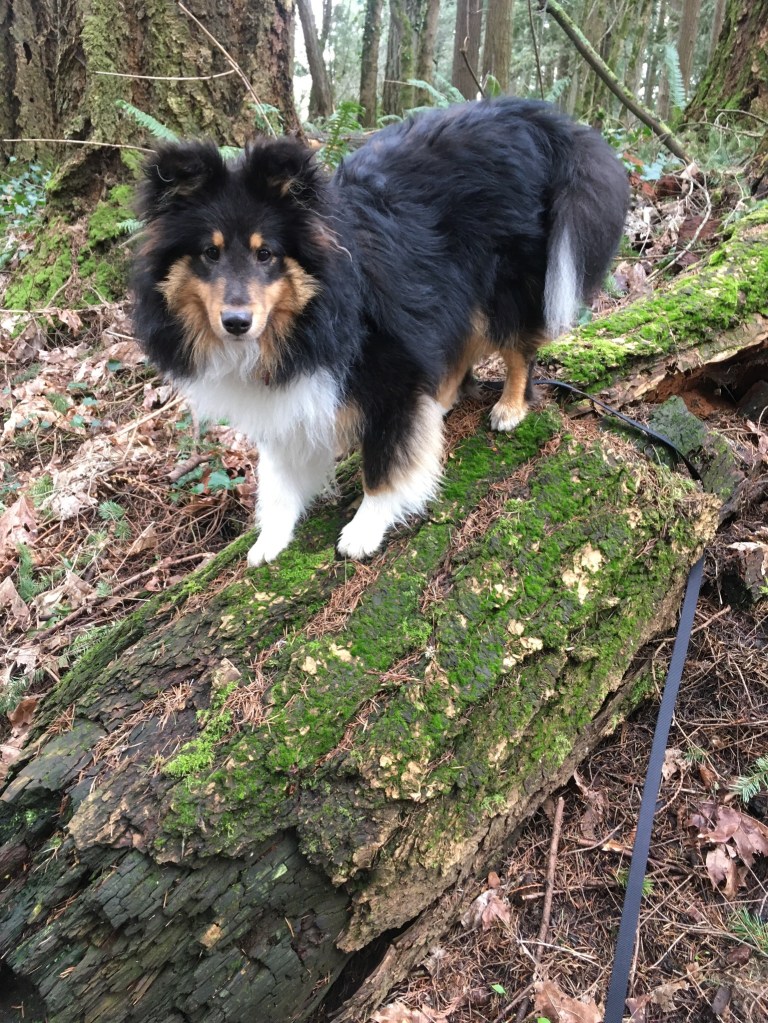
The dog remains neurotic — my anxious little Sheltie should have been named Busby Berkeley for the major production he makes out of every little thing.

The horse is now free range on the boarding stable grounds and living the Life of Riley. He primarily likes hanging out in the arena with the trainer during lessons. He just turned 30 and isn’t as spry as he used to be to avoid the pasture shenanigans. To prevent additional minor (so far) injuries he had a free range trial period that he passed. Other retirees at the barn have enjoyed similar privileges. I’ve always called him a goober — and he’s proving to be even more so than I thought.

Now to return to my usual pursuits following my adventurous detour.

Sidetracked

My second bedroom has served more as a storeroom than an actual bedroom. Sound familiar? In the 11 years I’ve lived here the spare bed was only used twice (when friends stayed over per post-cataracts surgery instructions). Since moving in I’ve been doing all my writing on a small desk in my bedroom. I offered the vintage bed and dresser occupying the room to a friend for their daughter, and they accepted the offer but wanted their talented friend to refurbish the pieces. Everyone’s schedules finally came together and the bed, mattress & box springs, and dresser vacated the second bedroom.

I finally had potential office space.

I had draft novels with associated research material and development binders crammed in my closet along with reams of printer paper and duplicated purchases of office supplies. You know how it goes. You already have the item you need but can’t find it, so you buy it again and end up with multiples in several locations. Many of my reference books and books on writing were stashed in the closet of the second bedroom that also serves as my pantry annex and mini storeroom. Other books were still in boxes.

Then there were the art and craft supplies that I rarely used because I lacked a usable workspace.

Wouldn’t it be wonderful to collect all these things in one location? A place with a computer table large enough to spread out a project. And a second location for note taking, art projects, crafting, etc. Imagine adding a comfy chair to the room for reading and watching TV.

And this is what I’ve been working on for several months. I surfed the net for furniture and storage ideas. Took measurements of the room and existing furniture. Played with floor plans. I gradually began to narrow my findings to potential purchases. I shoved the piles filling the bedroom to one side of the room. On the vacated space I set up an Ikea gaming table with plenty of room for computer and novel in progress. An existing small bookcase tucked in nicely beside it.

Obviously I needed more room for books and binders. What if I filled the entire long wall of the room with bookcases?! The hunt was on. But the bookcases I found online generally lacked adjustable shelves. Multiple matching bookcases either left vacant space along the wall or didn’t quite squeeze in. Custom wood cabinetry was too costly, since I also have a small kitchen project I should have addressed some time ago. I eventually located bookcases on the website of a big box office supply store that came close to what I wanted. However, the cost for three units to fill the available space (and a handyman to correctly secure them to the wall in earthquake/exploding volcano country) was in the ballpark of custom shelving.

Hmmm.

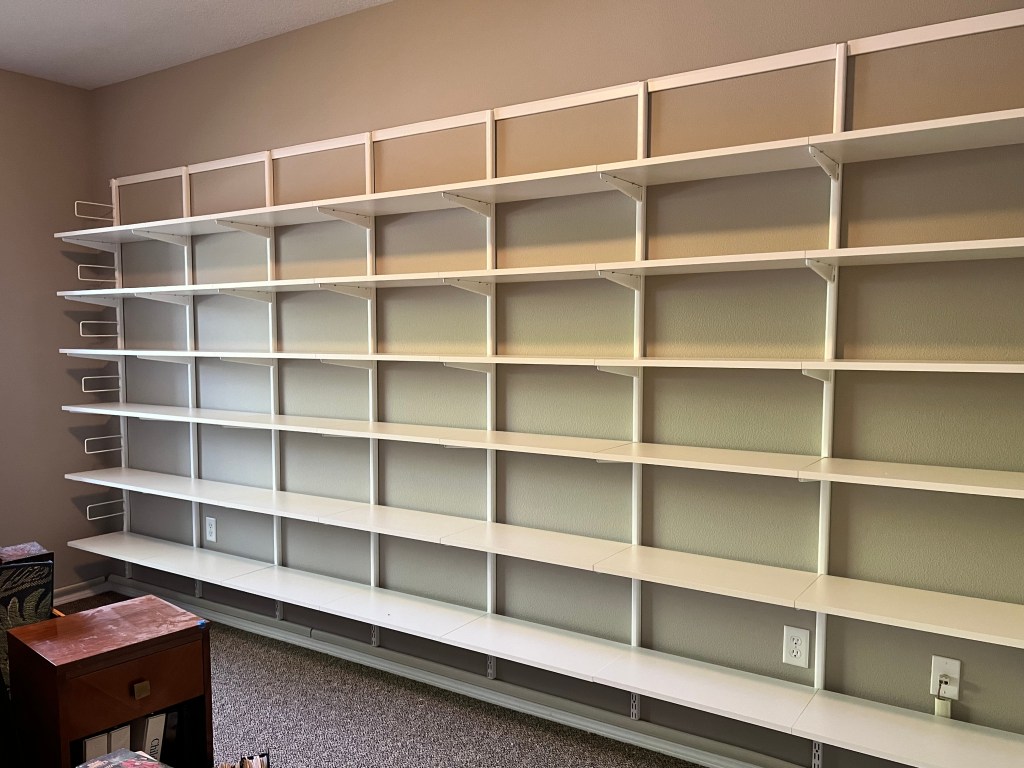
What you see above is my final decision. A custom system from a major home organization store. A designer with the store helped with the layout and materials list, and an installer familiar with the system secured it in place after we decided on the final arrangement. I now have a whole freaking wall of bookshelves!!

I’m presently in the process of filling up the shelves and working toward the floor plan I have in mind. There’s still the issue of a locked 1940s cedar chest with a missing key that could provide more storage when and if I can get in it. I’m sure it’s full of crocheted, embroidered and tatted items that I’ll take to a nearby vintage store. Don’t worry, I intend to disable the lock if I ever get it opened.

Even though sidetracked by the effort to create an office in the second bedroom, I’m still mulling over ideas for The Crystal Sword and I have two draft novels nearing completion.

Encouraging Recognition

I was congratulated by our instructor when I arrived for the third session of the fall writing class offered by our library. I’d taken first place in the library’s annual short story contest in the Adult Writer category. As I hadn’t received official notification I was pleasantly surprised and verified my success on the library website.

I entered the contest last year but didn’t make the top three. My story ideas are generally novel length — so the limitation of 1,500 words is difficult for me. Last year I condensed an existing Christmas story that required editing out what I considered some of the fun aspects of the tale about the North Pole ponies.

This year I created a story from scratch. In doing so I considered what I most appreciated in a short story and decided it was a twist at the end. O. Henry and Shirley Jackson came to mind. Then I thought about how this is done. Basically the characters, situation, and action of the story set up certain expectations for the reader. But interpreted differently the story provides a fair but surprising end that the reader didn’t see coming.

So how do I apply this to my story? As it happened, I was reading a novel about a story set-up I have in mind about a stand-in for a princess who takes the royal’s place in dangerous situations. The stand-in will need to be trained to convincingly imitate the princess and I was reading the novel to see how the author addressed this. Romance is a central aspect of the novel and it occurred to me that some of the descriptions of the characters’ physical symptoms of attraction could also apply to other emotions.

As these things go — an idea comes along, the lightbulb turns on, and the writer tries to capture the spark of inspiration. I created a protagonist that I placed in a setting that would send the reader down one path. I took inspiration from the romance genre for descriptive phrases, cognitive that they must also relate to the protagonist’s actual emotions. I imagined a fictional world that was similar to a couple of popular historical series on cable television. And I then attempted to capture the moment when the protagonist makes a decision that changes the whole meaning of the scene I’d prepared for the reader.

I spent a month writing and rewriting the story. As I tend to think in novel length, I had to find a means of succinctly transmitting information that would explain the ending without giving it away. So there was a lot of editing out, adding a bit back in, selecting the exact word instead of several, and so forth. After much massaging of the story I sent it off to my First Readers who approved of it (one pointed out a line of dialogue that also bothered me that I amended). There was nothing more left to do but submit my story days before the deadline.

The judges apparently agreed with my First Readers. The top stories in each category and the winning stories are available at the Wilsonville Library website. Note: the young writers’ stories are not to be skipped.

Muddle in the Middle is Real

So I had the radio on the local NPR station when Hidden Brain came on. The topic of the episode was breaking out of a rut [https://hiddenbrain.org/podcast/you-2-0-how-to-break-out-of-a-rut/]. It addressed the usual “midlife crisis” that many experience, but also included the problem many writers encounter: the Muddle in the Middle. You know, you have a great premise, a compelling opening, and perhaps a dynamic climactic scene. But what to do about all that stuff in the middle? Turns out it’s a real thing. The whole how-did-I-get-here-and-how-do-I-get-out is a natural part of human nature. So I guess we writers shouldn’t be too hard on ourselves when we bog down in the middle of a story or novel.

I have vague story idea (working title The Crystal Sword) with a huge gap in the middle. There is an origin story for the Protagonist and a climactic scene, but what happens between the two ideas is an ever-changing muddle. I have bits and pieces from other draft novels that I might use in this story instead. But I also have new ideas I might apply instead. Or maybe combine them somehow. The recent Strong Women Archetypes course at the library provided an approach to develop the characters of Crystal Sword. I’ve used various personality categorizing theories to help me flesh out characters, but hadn’t considered using archetypes. Class discussions about the earliest archetypal goddesses whose powers were reduced and attributed to various gods over time suggested one angle for my amorphous story idea. We’ll see. But I think I’m going to use character archetypes to create the four main characters of Crystal Sword. The Complete Writers Guide To Heroes & Heroines, Sixteen Master Archetypes (by Tami D. Cowden, Carol LaFever & Sue Viders) will be my go-to reference.

Beginning mid-September the library is offering “part two” of the spring course. This time the creative writing class will explore worldwide archetypes to inspire participants’ writing as well as personal heroic journeys. The course will analyze generational, gender based, and societal norms and prejudices, with an emphasis on the hero/shadow archetypes and how they differ for men and women. All genres of writing are welcome, as was the case in the previous course. We had memoirists, poets, nonfiction, and fiction writers — all of whom had wonderful pieces to share.. I’ve already signed up for this latest course and hope to see other returning participants.

Meanwhile, I continue to plug away on Draft VI of my Treasure Island novel. I keep looping back to edit, re-edit, re-re-edit before printing half a dozen pages at a time and moving forward. I’ve discovered some historical facts I need to correct, but will address those after I’ve worked through the entire novel.

It’s Been Awhile

It has been quite awhile since I’ve written. I suppose the main reason is I’ve been editing a couple of projects rather than creating new ones. Not much exciting to report about slogging through an edit.

I was working through The Quest for the Thing but went back to Lady Tedey’s Island of Treasure (my 2020 NANOWRIMO project inspired by RLS’s Treasure Island) as it seems more likely to be of interest to an agent or editor. This is draft VI. I work through maybe ten pages at a time, rereading them each time I reopen the document file. And each time I go over the same passages I continue to make tweaks until I say “enough” and print pages. Once printed I don’t go back. If I think of something that needs fixing I make a note on a Post It and affix it to the relevant page. Because Lady Tedey is set in 1834 and 1835, I continue to verify historical accuracy. I know I’ve made mistakes.

I took the local library’s spring writing class: Strong Women Archetypes. The instructor limited enrollment to women, which did not please the library management. However, it allowed participants to speak freely about our experiences in a patriarchical society. We ended up doing more of an exploration of the goddess archetypes from a variety of ancient cultures and the powers they represented. We also examined how revered goddesses were superseded by male gods. One participant has an ambitious goal to produce an experiential presentation centered on the Sumerian goddess, Inanna. (I don’t know about you, but my school studies were focused on the Greek and Roman gods. I had not heard of Inanna, nor realized she had so many over-arching powers that were later assigned to the male gods of the Greeks.) Other class participants wrote poetry related to the female experience, often relating to archetypical expectations imposed on women. I decided to use archetypes to develop the main characters for one of my vague story ideas and drafted an opening scene. The instructor hopes to offer another course on archetypes in the fall, this time for anyone interested.

I continue to be distracted by nebulous story ideas that involve a crystal sword, or centaurs, or the look-alike stand-in for a princess. But I also like the idea of adapting traditional adventure stories with male protagonists into tales with female main characters. So I’m going to see if RLS’s Kidnapped is applicable to one of my existing ideas or inspires a new storyline.

?The End?

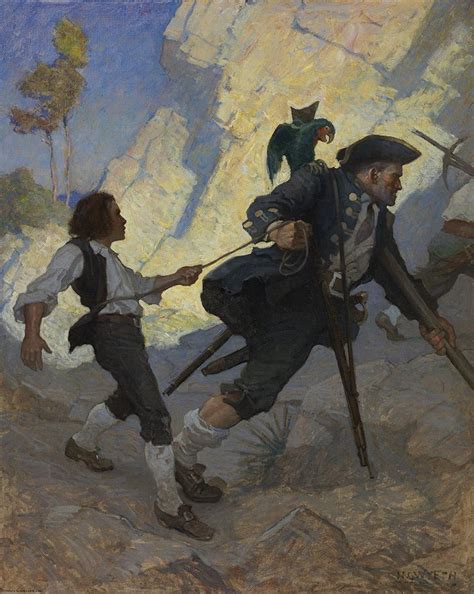
Painting by N. C. Wyeth

I briefly set aside work on what I call “Treasure Island Her Way.” More about that later.

But I am still working on draft four of Lady Tedey’s adventure story. I’ve set up Theodosia Bryant’s 1834 pre-adventure life, sent her “across the threshold” to deal with allies and enemies, brought her close to death, and brought her back home.

So how do I end the story?

Robert Louis Stevenson isn’t much help. Jim Hawkins returned to his mother and the inn and declared he was done with adventure. So I’m on my own.

Research revealed an event in Princess Victoria’s life that provided a great bookend to end the story with a second cameo by the future queen. I manipulated the story timeline to situate Lady Tedey in the right time and place. But my attempts to wind up the tale were unsatisfactory.

Dog walks and barn time are excellent for mulling over story problems. Not sure which critter I can credit, but I realized two lines of dialogue near the conclusion of the story provided an opportunity to demonstrate how the character of Tedey has evolved. So I rearranged some scenes, drafted the new scene, and ended up with what for now seems to be a usable ending.

I still have to tweak the final chapters. But now I have something to work with before initiating draft five.

Brief Diversion:

Among the local library’s summer programs is a short story contest. I don’t normally work with a 1,500-word limit but thought I’d give it a try. Years ago I wrote a Christmas story where ponies save the day. Since the original tale was much longer than the contest limit, I really had to condense it. Good exercise to determine what scenes and elements are critical to the story. Anyway, I have what I think is a tale worth submitting. I have until the end of the month, so I’ll let it sit a few days before going over it again. Each time I reread it I made edits. Good thing there’s a submittal deadline!

Anyway — fun project.

Additional Diversion:

I have a folder on my computer labeled “Magical Mashup.” Trying to mine “cool” ideas from various story ideas can be overwhelming. Obviously, I can’t cram them all into a single tale. But deciding which ones I want to use is proving difficult. No sooner do I have an idea, a new one pops up. I have a protagonist. I have a MacGuffin that instigates turmoil. And I have inspirations for the story world. So I’ve returned to adventure stories for inspiration with a thought to again changing the main character into a female. I’m Googling plot summaries, and highlighting as I reread novels that might prove helpful. We’ll see what comes of it.

Complications of Historical Accuracy

Early in my version of Treasure Island with a female protagonist I include an incident that actually happened to Princess Victoria before she became Queen of England. My protagonist plays a minor role in the episode and I drafted the scene based on a description I located during my research. From there I drafted the story using Treasure Island as my guide. Note, the first draft was completed during NANOWRIMO 2020. Getting words on the page was the goal each time I sat at the computer.

Draft two was an effort to clarify the narrative. Correcting the I-knew-what-I-meant-at-the-time problem of missing information, confusing pronouns, and so forth. I was part way into draft three when I realized I needed to keep track of the number of days the scenes covered and where they would be on the 1834 and 1835 calendars. The 1834 incident at the beginning of the novel had established the timing of everything that followed.

I wasn’t satisfied with the ending of the novel and wondered if there was a way to connect it back to the beginning of the story. So I went down the rabbit hole of online research to discover a possibility within the needed time frame.

That’s when I finally accessed pages of Princess Victoria’s journal that described the the 1834 incident with more accuracy than my original source (talk about firsthand witness!). Which indicated my scene needed to be rewritten. In matching scenes in the draft novel to the actual calendars I came across a major historical event that would have affected a minor character, so I had to at least reference it. Then I discovered a potential scene for the end of the novel at a specific location and date — provided it included Princess Victoria. I delved deeper into the rabbit hole on a topic I hadn’t originally expected to include in the novel. This raised more historical accuracy issues: if I could substantiate Princess Victoria’s presence for the intended scene, was it plausible for my protagonist to be back in England by that specific date.

ARGH!

And I thought it was difficult enough adapting a female protagonist at a different time period into the story framework of Treasure Island.

I think I finally have a handle on fitting the required scenes to tell a version of Treasure Island into actual historical events. Now to make sure I’ve included sufficient characterization into the this-happened-and-then-this-happened story action.

Distraction

I’ve never had children, but I have a new respect for the parents of toddlers. My two previous Shelties were a year old when they entered my life. This guy is my first puppy and has proven to be a challenging one on top of dealing with general “puppyness.”

Magical Mashup, my most recent writing effort, is an attempt to meld aspects from several other projects. It’s been a matter of gathering the character and plot point material developed for various other novels and massaging it for this new approach. This has involved editing existing background information, developing new characters, and establishing timelines. I finally reached a point where I began writing an opening scene for the main character, but with so much happening concurrently at other locations in the story a straight timeline approach to the draft didn’t seem feasible. I decided the best approach might be to write character-by-character for the three most influential individuals and then combine them in a logical manner. All of this has required a lot of focus to keep all the pieces in place.

Enter the Distraction.

Puppies have frequent potty needs. Lacking a fenced yard, this requires me to stop what I’m doing to take the dog outside to conduct his “business.” This has also resulted in a lot of unsuccessful outings in attempts to interpret puppy signals and prevent accidents. No yard also requires a lot of puppy walks. In other words, a lot of interruptions to writing focus. As the pup has matured the periods between outings has increased, and he will now snooze long enough for me to actually accomplish tasks.

However…the breaks in concentration resulted in my setting aside Magical Mashup for longer and longer periods. Yet I needed to work on something!

Re-enter Lady Tedey.

My female approach to Treasure Island was in second draft and had been set aside long enough to view it with a new eye. So I’m reading through it for coherency and making minor changes. Once this read-through is completed I hope to go back through it to add more depth to the characters. Since it was my 2020 NANOWRIMO effort, speed writing 50,000 words can skip over a lot of background and character elements.

I also have in mind the 2022 Willamette Writers Conference that will be back in person this year (COVID permitting). If there is a likely agent or editor in attendance, I may work up the courage to pitch Treasure Island done her way.

So maybe the puppy distractions will have a positive outcome.