Ma’rama, Daimyo’s Daughter

Ma'rama

Ma’rama, Daimyo’s Daughter is the working title of my completed young adult fantasy novel.

Ma’rama is the spirit medium daughter of an aristocratic family who rejects the supernatural ability she shares with her geishmiko twin sister until the survival of the empire depends on Ma’rama’s gift. The novel is set in the island empire of Taykoku Koganay Ree’ukyuu where the three races that comprise the Golden Empire of the Crested Eagle (inspired by Maori, Japanese, and Scandinavian cultures) have attained an era of peace. When the story opens sixteen-year-old Ma’rama is struggling to establish a separate identity by defining herself as who she’s not – her much-praised twin, Hahana.

Following the emperor’s death the young Emperor Heir is guided by the Throne Marshal and the Council of Five noblest daimyo dukes. As the noble families arrive in the capital for the Season, Ma’rama (Mara) plots the disruption of a possible arranged betrothal. Despite their differences, Mara and her twin Hahana (Hana) share an unusual bond that unites them when their privileged lives are turned upside down by a bloody coup.

Tamura Shigeru believes he alone can protect the empire from the khan of Mughalstan when the Throne Marshal and Council of Five disregard his warning of an invasion. Shigeru’s men assassinate the Council of Five and their families, but Mara and Hana miraculously escape and flee for their lives with the help of a family retainer and a band of brigands. Mara wants to return to the family’s rural estate on one of the northern islands, but when she and Hana learn the deceased emperor’s first-born son did not die at birth but was instead hidden away at the Cloud Shrine, the sisters make for the island’s tallest mountain to locate the hidden prince.

Tamura Shigeru is determined to eliminate the twin sisters that threaten his plans.
Step Away From the Computer

IndyEndofleash051715

The advice to writers is to place butt in chair and write. But sometimes it’s a good idea to step away from the computer (or in my case the ballpoint and paper) and get out of the house.

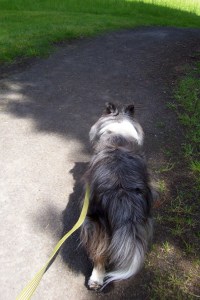
Since I have no fenced yard I make several “”business trips” each day with my dog. I’ve experienced many a story solution or revelation during these outings. Sometimes I’m purposely mulling over a story problem as we set out on our walk. Other times the mental lightning bolt strikes and I come up with revisions for the morning’s or previous day’s scribbles. Fresh air is good for the brain as well as the body. Even sloppy wet days (when properly suited up in rain gear) offer the opportunity for new insights when strolling with your canine BFF.

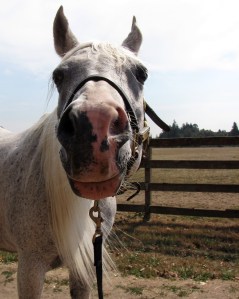
I also own a horse that I ride 3-4 days a week. Collecting him from pasture and grooming before and after the ride is similar to walking the dog. The mind can wander while conducting routine tasks. I may develop a bit of dialogue while brushing my horse and transferring hair from him to me. Or a descriptive phrase will pop into my head while removing shavings from his tail. But once in the saddle the focus is on riding. And that’s when the story ideas can percolate subconsciously. Fresh air, exercise, and story development. What’s not to like?

Don’t chain yourself to your writing implement, no matter how mobile. Walk away from your laptop, put your iPhone in your pocket, set aside pen and paper. Go do something and free your mind to figure things out on its own.

Phantom20_5

Outliner

ComputerDesk_030511Outliner or “pantser?”

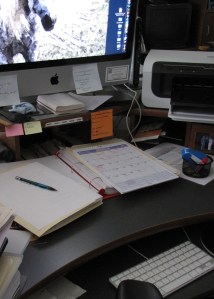
I’m an outliner. It’s saved my life. After reading numerous books on writing fiction and attending conferences, workshops, and classes I’ve taken the bits and pieces that work for me as a guide through the hundreds of pages of a novel.

Yep…the shuffled 3×5 cards with scenes scribbled upon them.

But I find the outlines aren’t as restrictive as pantsers fear. In a way, it frees me up since I don’t have to stress over what comes next. I know what I’m writing toward. And I still get surprises. Characters intervene that I didn’t know were part of the story when I began outlining. Scenes combine or separate as needed. I delete cards or add scenes that weren’t captured on a card. The outline is flexible. Like an old fashioned paper map — the freeway is clearly marked, but the tempting side roads are there to explore.

Not to say I don’t pants it. That seems to occur while I’m researching the story. I take notes in composition books and always set aside pages for ideas as they come to me. Sometimes the ideas work, sometimes not. And they often evolve over the process of forming the novel.

For me, once I know the major plot points I can imagine the scenes needed to arrive at and depart from those points. Yet each scene is an unknown until it hits the page. I may know ahead of time what I want to happen. But I never know how it will happen until fine-point pen moves across the 3-hole punched binder paper. Even with an outline, each day’s writing is a bit of a revelation.

Character Development Tricks

During the process of developing the characters in my novels I search for images that resemble or inspire the physical description of the primary actors. I used to page through magazines and catalogues to cut out pictures. Now I use the Internet.

Sometimes I have a specific person in mind. Other times I seek a “type.” Because I write young adult novels, I’m often on the hunt for pictures of actors during their high school years.

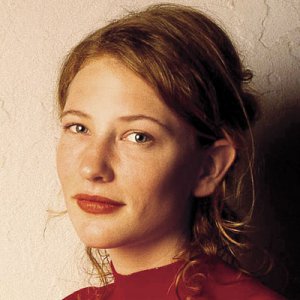
cate-blanchett-400The appearance of Bronwynn (protagonist of Lace Reader) was inspired by Cate Blanchett when she appeared as Elizabeth I. But Bron is fifteen and Ms. Blanchett was older than that when the film was made. So I searched for the most youthful images I could find of the actress.
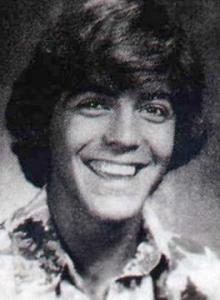


Neville has remarkable blue eyes that crinkle attractively when he smiles. His martial skills are lacking but he takes the teasing he receives in good stride. A young George Clooney seemed to fit the bill.

georgeclooney


300px-StuartAlanJones

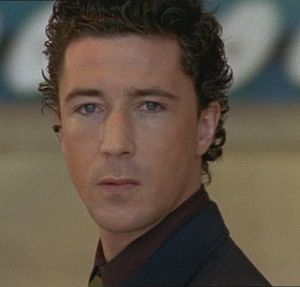
Penryn is a privileged youth who is self-serving and always has an eye on his future. Bron is flattered by his attentions, but should she be? Stuart Alan Jones portrays an attractive yet conniving character in A Game of Thrones and seemed right for this role, too.

Using pictures that resemble the characters I have in mind helps me imagine how they might speak and move through the world I created for them. And when the inspiration for a character is an actor, I can take advantage of their screen presence to observe them in action.

Of course, this is only the outward appearance of the characters in my novel. But a great starting point as I delve deeper into the people of my story.

Encouraging Words

typewriter_2

I continue to work on The Last Lace Reader (working title subject to revision as The Last Web Reader). This is a young adult fantasy set in a world where magic exists but most cultures have chosen to restrict the magical races to the fringes.

I began the novel for Cynthia Whitcomb’s Screenwriting Class so I could apply her methods to a new venture rather than a completed project. Fortunately, the world building and research had been completed years ago for an earlier novel and amended for subsequent stories. Other than screenplay formatting, everything covered in Cynthia’s class is applicable to novels. While most of the writers in the Fall 2015 class were screenwriters, there were a few novelists.

The class included scene readings and comments from fellow classmates as well as Cynthia. At the conclusion of the class we had the wonderful opportunity to submit a completed screenplay or up to 100 pages of our novel to Cynthia for her professional review.

Cynthia’s editorial comments on my opening scenes were in line with my own assessments of the first draft. Her words were very encouraging.

Writers work in a vacuum. And because we work alone it is easy to lose perspective. Most often we are overly critical of our work. This makes us fearful of putting it out for others to see. So encouraging words from fellow writers, and especially those who’ve been successful out in the real world, mean a lot to those of us still toiling away in private.

I think the the books read, conferences attended, classes/workshops taken are beginning to gel. I’m on the verge of figuring out this novel writing thing.